

8 Guitarists Every City Pop Guitarist Should Know
If you want to get better at playing City Pop guitar, there’s an easy trap to fall into:
You only listen to City Pop guitarists.
Makes sense, right?
But a lot of the guitar language you hear in City Pop didn’t magically appear in Japan in 1980.
There’s funk.
There’s soul.
There’s R&B.
There’s jazz fusion.
There’s AOR (Adult-Oriented Rock).
And then Japanese musicians took all of that vocabulary, mixed it together, and created something that sounds very much like its own thing.
So this isn’t going to be a list of “the 8 greatest Japanese City Pop guitarists.”
Instead, these are 8 guitarists I think anyone interested in playing City Pop should spend some time studying.
Some of them are directly connected to City Pop.
Some of them aren’t City Pop guitarists at all.
But you’re going to hear a lot of familiar sounds.
1. Nile Rodgers
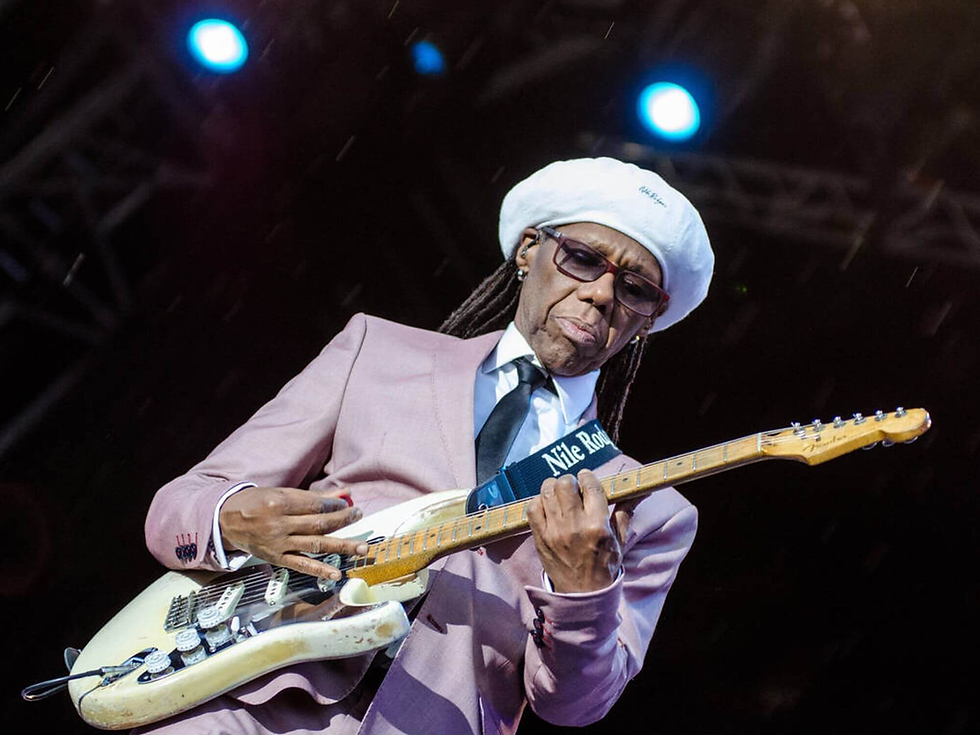
Let’s start with the obvious one.
Nile Rodgers is one of the first guitarists I’d recommend to anyone trying to improve their City Pop rhythm playing.
Listen to Chic and you’ll immediately hear why.
The guitar is clean.
The chords are usually small.
There’s tons of muting.
And the right hand is basically functioning as part of the rhythm section.
This is important because a lot of guitarists approach City Pop by learning increasingly
complicated chords.
eg. Maj7, Maj9, m11, 13ths, etc.
And yes, all of that is useful.
But if your rhythm playing is stiff, those fancy chords aren’t going to save you.
A three-note chord played with great 16th-note feel will usually sound better than a six-note maj9 chord played badly.
That’s the lesson.
What to steal: the right-hand groove, muting, small chord shapes, and the ability to make very little guitar sound like a lot.
2. Al McKay

If Nile Rodgers is one flavor of funk guitar, Al McKay is another.
McKay is best known for his work with Earth, Wind & Fire, and his rhythm playing is ridiculously tight.
But compared with Nile, I tend to hear his playing as a little more syncopated and a little more active.
You get chord stabs✔
Single-note lines.✔
Little rhythmic figures.✔
Parts that pop in for half a bar and disappear again.✔
And that’s incredibly useful for City Pop.
One of the things that makes a good City Pop arrangement work is that the guitar doesn’t
necessarily play the same thing for four minutes straight.
Sometimes it’s a chord.
Sometimes it’s a little funk line.
Sometimes it’s nothing.
(That last one is particularly difficult for guitarists. 😆)
What to steal: syncopation, chord stabs, single-note funk ideas, and knowing when to stop playing.
3. David T. Walker

Now we move into the smoother side of things.
David T. Walker is one of those guitarists where you might not immediately recognize the name, but once you start listening to his style, you’ll probably recognize the vocabulary.
Little double-stops.
Slides.
Chord fills.
Tiny melodic answers between vocal phrases.
Beautiful little ideas that appear for two seconds and then get out of the way.
This is one of my favorite things about good R&B guitar playing.
The guitarist isn’t constantly screaming:
“LoOk! I kNoW cHoRdS!”
They’re just adding small pieces to the arrangement.
And if you’re trying to play the softer, more soulful side of City Pop, this kind of playing is incredibly useful.
What to steal: double-stops, melodic fills, chord embellishments, and space.
Cornell Dupree

Cornell Dupree is one of those guitarists who makes you realize how little you actually need to play.
His style is rooted in R&B, soul, funk, and blues, and he spent decades as one of the great session guitarists, playing with artists like Aretha Franklin, King Curtis, Donny Hathaway, and many others.
If you want a good course in rhythm guitar with little R&Bish trills fills and pocket, go and check out this Donny Hathaway live record with him playing on it:
What I love about Dupree is the pocket.
He doesn’t usually sound like he’s trying to impress you.
He’ll play a tiny chord stab.
A short fill.
A little bluesy phrase.
Maybe two notes.
And somehow it sounds completely right.
That kind of playing is incredibly useful for City Pop, because a lot of the best guitar parts are not really “guitar parts” in the traditional sense.
They’re little pieces of the arrangement.
The guitar shows up, adds some rhythm or color, and then gets out of the way.
And that’s much harder than it sounds.
A lot of guitarists spend years learning how to play more.
Dupree is a great example of why learning how to play less can sometimes make you sound much better.
What to steal: pocket, short R&B fills, bluesy phrasing, chord stabs, and knowing exactly when not to play.
5. Tatsuro Yamashita

Okay, Now we’re FIRMLY in City Pop territory.
Tatsuro Yamashita obviously doesn’t need much introduction if you already listen to this genre.
But I think guitarists sometimes focus so much on his songwriting and production that they overlook how good his rhythm guitar playing is.
Just listen to Sparkle.
That guitar part basically tells you half of what you need to know about City Pop rhythm guitar.
Clean tone.
Tight 16th notes.
Small chord shapes.
Lots of percussion in the right hand.
And most importantly:
It grooves.
Again, this is where I think guitarists sometimes get distracted by harmony.
Yes, the chords matter.
But the groove matters more than people think.
You can play the “correct” City Pop chords and still sound nothing like City Pop.
What to steal: cutting, rhythm accuracy, clean chord voicings, and fitting inside a dense arrangement.
6. Makoto Matsushita

If Tatsuro Yamashita represents one side of City Pop guitar, Makoto Matsushita represents another.
This is where things start getting harmonically fancy.
If you haven’t listened to First Light, start there.
You’ll hear funk.
AOR.
Fusion.
Sophisticated chord voicings.
Really smooth voice leading.
And a lot of those sparkly, shimmery guitar sounds that people now associate with City Pop.
This is also a great player to study if you’re tired of playing the same gigantic root-position maj7 and m7 chords.
You start hearing smaller upper-register shapes.
Inversions.
Extensions, etc.
Chords where the guitar might only be playing three notes because the bass and keyboards are handling everything else.
That’s a big City Pop lesson by itself.
You don’t have to play the entire chord.
What to steal: extended harmony, voice leading, inversions, and smaller chord shapes.
7. Masayoshi Takanaka

Masayoshi Takanaka is the guy to check out if you’ve spent the last six months working on City
Pop rhythm guitar and suddenly think:
“What about lead lines?!”
Ready to Fly is a great place to start.
Takanaka comes much more from the jazz-fusion side of things.
There’s more lead guitar.
More melodic playing.
More technical vocabulary.
More colorful tones.
But the thing I really like about his playing is that it still sounds melodic, but you don’t feel like you’ve accidentally walked into a guitar clinic.
Even when the playing gets sophisticated, you can usually follow the musical idea.
And that’s something worth stealing.
What to steal: melodic solo construction, fusion vocabulary, articulation, and making technically advanced playing still sound like music.
Shigeru Suzuki

Finally, we have Shigeru Suzuki.
Suzuki came out of Happy End and went on to become one of the important guitarists and session players in Japanese popular music.
His solo album Band Wagon is a great place to start.
But the reason I wanted him on this list is something a little less flashy:
Taste.
Good studio guitar playing is often about making the song better without demanding attention.
That might mean one fill.
One little chord inversion.
One melodic answer.
Or just not playing during a section where the keyboards already have everything covered.
This is something that takes guitarists a surprisingly long time to learn.
We like playing guitar.
So naturally, our solution to most musical problems is:
MORE GUITAR.
Unfortunately, that is not always the correct answer. 😆
What to steal: restraint, accompaniment, tasteful fills, and learning to play for the arrangement instead of for yourself.
So what should you actually practice?
You don’t need to learn the entire discography of all eight guitarists.
I would say make a playlist of these guitarists and just start casually listening to them.
Then start stealing little pieces.
Take one rhythm.
One chord shape.
One fill.
One phrasing idea.
etc.
And try using it in your own playing.
That’s usually much more useful than trying to learn “the City Pop scale” or memorizing 25 fancy chords and hoping everything somehow starts sounding Japanese. 😆
City Pop guitar is really a collection of different musical languages.
The more of those languages you understand, the easier it becomes to sound convincing.
Want help learning City Pop guitar?
If you love City Pop but you’re not sure how to turn all of these chords, rhythms, fills, and guitarists into something you can actually play, that’s exactly the kind of thing lessons are useful for.
We can work on:
City Pop chord voicings
funk and 16th-note rhythm guitar
muting and cutting
R&B-style fills
improvisation
and actually applying all of this stuff to real songs
I teach private guitar lessons in Takadanobaba and online, in English or Japanese, and lessons are built around the music you actually want to play.
If you’re interested, you can check out the trial lesson page here:


Comments